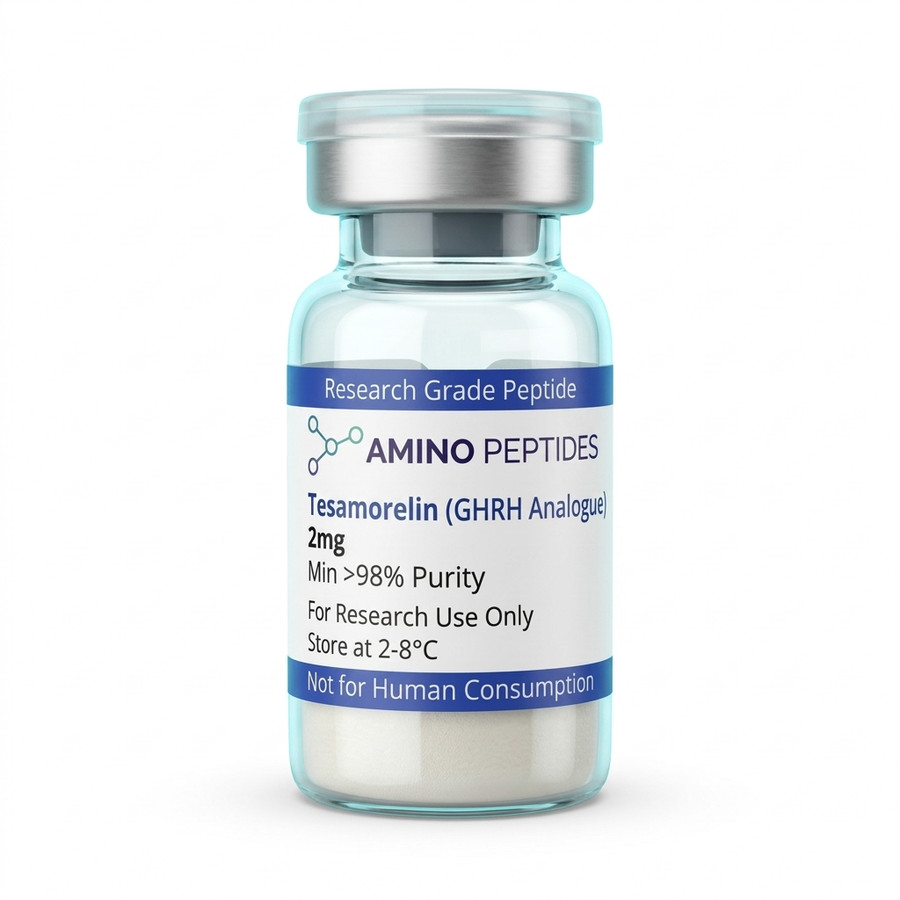
Tesamorelin is a synthetic 44-amino acid analogue of growth hormone-releasing hormone (GHRH), engineered for enhanced molecular stability in laboratory environments. Through advanced peptide synthesis, this compound features a trans-3-hexenoic acid group attached to its N-terminus, which protects it from rapid enzymatic degradation by dipeptidyl peptidase-4 (DPP-4) in cellular assays. As a premium research chemical, UK laboratories utilise this peptide to investigate somatotropic signalling cascades and lipolysis mechanisms in vitro. When studying its binding affinity to pituitary cell receptors, researchers must follow strict optimising tesamorelin reconstitution protocols to maintain the structural integrity of the lyophilised powder. By interacting with the GHRH receptor, it triggers a cyclic AMP (cAMP) dependent pathway that promotes the transcription and release of specific growth factors. For detailed structural data, researchers can consult its PubChem profile. Proper handling and precise reconstitution protocols are essential to ensure consistent and reliable data during long-term cellular studies.
Public search data clusters around the phrase 'GHRH analogue' when exploring molecular stability and receptor affinity models. Current literature focuses on how the trans-3-hexenoic acid modification alters enzymatic degradation rates in isolated cell cultures. Amino Peptides supplies this compound only as a lyophilised laboratory reagent. Strictly for laboratory research.
- Binds with high affinity to the growth hormone-releasing hormone receptor (GHRHR), a class B G-protein coupled receptor (GPCR) expressed on anterior pituitary somatotrophs in vitro.
- Interacts with the N-terminal extracellular domain of the GHRHR, initiating conformational shifts necessary for intracellular G-alpha-s subunit coupling.
- Demonstrates specific ligand-receptor kinetics that are modulated by the trans-3-hexenoyl moiety, enhancing resistance to dipeptidyl peptidase-4 (DPP-4) cleavage in cell-free assays.
- Evaluated in radioligand binding assays to determine competitive displacement of endogenous GHRH at the somatotroph receptor interface.
- Catalyses the exchange of GDP for GTP on the G-alpha-s subunit, leading to the activation of adenylate cyclase and a subsequent surge in intracellular cyclic AMP (cAMP) concentrations.
- Elevated cAMP levels activate Protein Kinase A (PKA), which phosphorylates downstream targets including the cAMP response element-binding protein (CREB) in isolated cellular models.
- Promotes the transcription of the POU1F1 (Pit-1) gene, driving the synthesis and vesicular exocytosis of growth hormone (GH) in in vitro somatotroph cultures.
- Modulates intracellular calcium transients by activating voltage-gated calcium channels via PKA-dependent phosphorylation, facilitating SNARE-mediated vesicle fusion.
Technical Specifications
Variant Breakdown
- 2mg Vial: Ideal for preliminary binding assays and short-term receptor affinity studies.
- 5mg Vial: Suited for mid-level in vitro experiments requiring multiple assay replications.
- 10mg Vial: Recommended for comprehensive cell culture studies and extended signalling cascade mapping.
- 20mg Vial: Designed for high-throughput screening and long-term longitudinal stability testing.
Quality Assurance
- HPLC Analysis: High-performance liquid chromatography ensures a purity level exceeding 99%, confirming the absence of synthesis by-products.
- Mass Spectrometry: Verifies the exact molecular weight (5136 g/mol) and structural identity of the synthesised peptide.
- Lyophilised Form: Processed into a stable, freeze-dried solid to preserve molecular integrity during storage and transport.
- Laboratory Characterisation: Rigorously tested for endotoxin limits (<0.5 EU/mg) to prevent interference in sensitive cellular assays.
Research Mechanism
- Receptor Binding: Binds with high affinity to the GHRH receptor located on the surface of target somatotroph cells in vitro.
- Signal Transduction: Activates the adenylate cyclase pathway, leading to a significant intracellular increase in cyclic AMP (cAMP).
- Gene Expression: Elevated cAMP levels activate protein kinase A (PKA), which subsequently triggers the transcription of specific growth factor genes.
- Enzymatic Resistance: The addition of a trans-3-hexenoic acid group at the N-terminus prevents rapid cleavage by DPP-4, extending the active duration of the peptide in culture media.
- Lipolytic Activity: Stimulates secondary biochemical pathways that upregulate lipolysis and alter lipid metabolism in isolated adipocyte models.
Reconstitution & Storage Data
| Vial Strength | Solvent Added | Resulting Concentration |
| 2mg | 1 mL Bacteriostatic Reconstitution Solution | 2.00 mg/mL |
| 2mg | 2 mL Bacteriostatic Reconstitution Solution | 1.00 mg/mL |
| 5mg | 1 mL Bacteriostatic Reconstitution Solution | 5.00 mg/mL |
| 5mg | 2 mL Bacteriostatic Reconstitution Solution | 2.50 mg/mL |
| 10mg | 1 mL Bacteriostatic Reconstitution Solution | 10.00 mg/mL |
| 10mg | 2 mL Bacteriostatic Reconstitution Solution | 5.00 mg/mL |
| 20mg | 1 mL Bacteriostatic Reconstitution Solution | 20.00 mg/mL |
| 20mg | 2 mL Bacteriostatic Reconstitution Solution | 10.00 mg/mL |
- Lyophilised (Powder): Store in a standard refrigerator (2-8°C) for up to 3 months. For long-term preservation, freeze at -20°C.
- Reconstituted (Liquid): Store at 2-8°C (Refrigerated).
Scientific References
Peptides: "Stability and receptor binding of N-terminally modified GHRH analogues in cellular assays" View Study
Journal of Endocrinology: "Dipeptidyl peptidase IV cleavage of growth hormone-releasing hormone and its synthetic analogues" View Study
Endocrinology: "Mechanisms of lipolysis induction by somatotropic signalling in isolated adipocytes" View Study
Biochemical Pharmacology: "In vitro characterisation of tesamorelin binding kinetics and cAMP activation" View Study