
CJC-1295 with DAC vs. No DAC: Understanding Half-Life Differences
3rd Jul 2026

What You Need to Know About CJC-1295
- Researchers frequently compare these two peptides because both are built from the same 29-amino-acid core, yet a single chemical attachment changes how long they stay active in the bloodstream from minutes to days.
- The version with the affinity complex latches onto albumin—a common blood protein that acts like a protective cargo ship—shielding the peptide from rapid breakdown by enzymes.
- Without that albumin-binding anchor, the shorter-acting Mod GRF 1-29 clears the bloodstream in about thirty minutes, creating a brief, sharp signal rather than a multi-day wave.
- Published studies in laboratory models observed that the long-acting version kept baseline growth hormone and IGF-1 levels elevated for over a week while still preserving natural rhythmic pulses.
How Albumin Hitchhiking Splits One Sequence Into Two Timing Profiles
CJC-1295 with DAC attaches to circulating serum albumin to remain active for up to eight days, while CJC-1295 No DAC clears from laboratory models in roughly thirty minutes. This single structural variation determines whether pituitary receptors experience a continuous baseline elevation or a rapid, short-lived signalling pulse.
To see why these two versions behave so differently, it helps to look at the natural hormone they mimic. Growth hormone-releasing hormone, or GHRH, consists of forty-four amino acids, though only the first twenty-nine are required to trigger pituitary receptors. Natural GHRH breaks down in less than ten minutes because an enzyme called dipeptidyl peptidase-4 (DPP-4) rapidly clips its chain. Biochemists solved this early breakdown by swapping four specific amino acids at positions two, eight, fifteen, and twenty-seven. That four-substitution twenty-nine-amino-acid sequence is known in laboratories as Mod GRF 1-29, or CJC-1295 No DAC.
Because CJC-1295 No DAC lacks the extra tail, it delivers its signal to the pituitary gland, triggers a sharp wave of cyclic adenosine monophosphate (cAMP), and clears out within half an hour. That brief window closely mimics the natural nocturnal waves observed during deep slow-wave sleep cycles and post-exertion cellular recovery. Pituitary somatotroph cells get a clear signal to release stored growth hormone, followed by a quiet rest period that keeps the receptors fresh and responsive.
Adding the Affinity Complex—abbreviated as DAC—changes the clock completely. The DAC attachment adds a lysine linker and a reactive chemical group called maleimidopropionic acid (MPA) to the end of the peptide chain. Once introduced into a biological system, this MPA group seeks out and forms a permanent covalent bond with a specific free cysteine molecule (Cys34) on serum albumin, the most abundant protein in blood plasma.
Albumin circulates for weeks before the body recycles it. By hitching a covalent ride on albumin, CJC-1295 with DAC shields itself from kidney filtration and enzymatic breakdown. Instead of clearing in thirty minutes, the albumin-bound complex stays in circulation with a measured half-life between six and eight days. Rather than producing a single thirty-minute wave, it creates a steady, week-long elevation in baseline GHRH receptor signalling, driving continuous downstream insulin-like growth factor-1 (IGF-1) synthesis in hepatic tissue models.
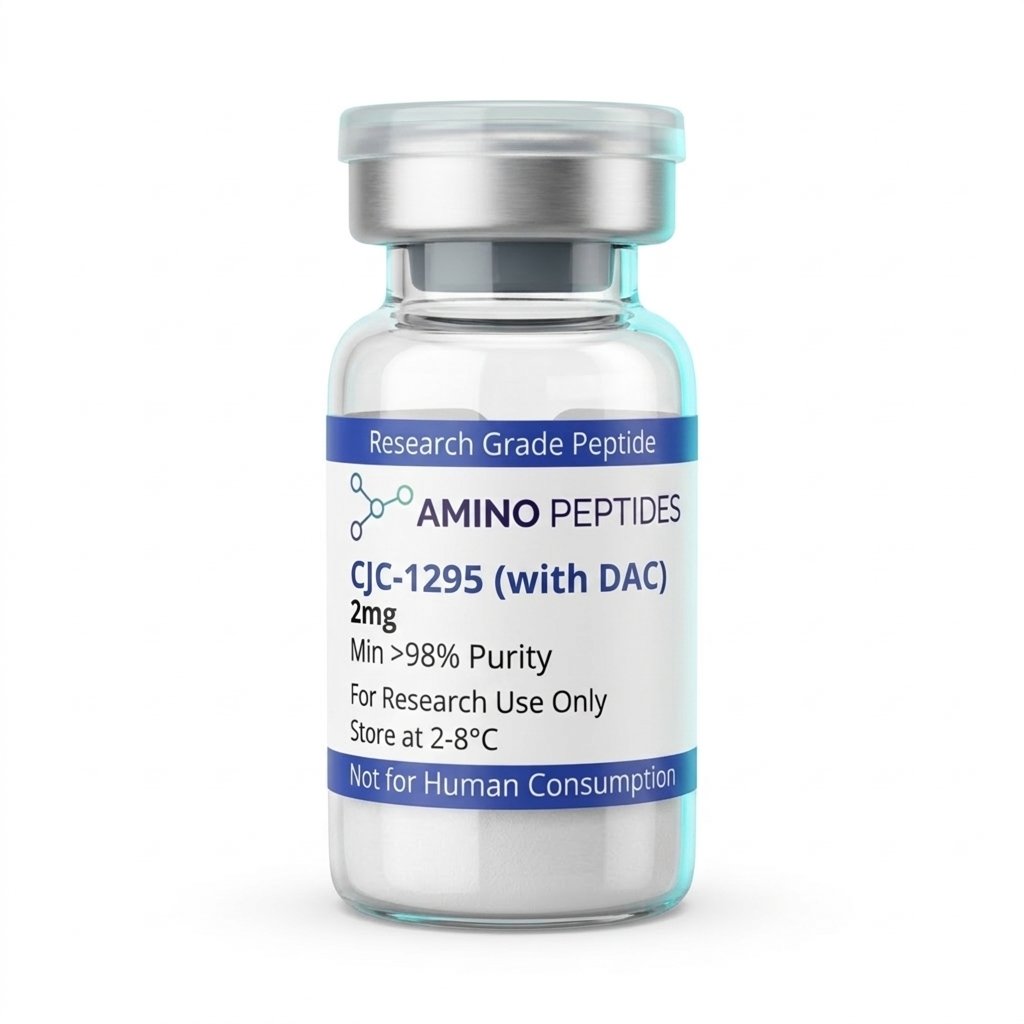
CJC-1295
From £22
Supplied as a sealed freeze-dried vial (stable 12–24 months at 2°C–8°C in a standard refrigerator).
Shop CJC-1295 →What Published Studies Track From Minute Thirty to Week Eight
In published studies, the divergence between these two peptides shows up within the very first hour of observation. When researchers introduce CJC-1295 No DAC into preclinical models, plasma concentrations peak within fifteen minutes and return near baseline by minute sixty. During this tight window, somatotroph cells release a distinct pulse of growth hormone that peaks around thirty to forty-five minutes. Within two hours, the immediate signalling event is finished, leaving zero residual peptide in the bloodstream. When repeated at timed intervals over several weeks, laboratory models show steady improvements in nitrogen retention, collagen synthesis markers, and cellular recovery rates without receptor fatigue.
CJC-1295 with DAC follows a completely different schedule. During the first two hours, the maleimide group finishes latching onto circulating serum albumin. Published studies tracking plasma concentrations show that a single measured level of CJC-1295 with DAC raises growth hormone output twofold to tenfold for six full days. Downstream IGF-1 levels begin climbing after twenty-four hours, peak around days three to five, and stay above baseline for nine to eleven days after a single exposure.
Between weeks two and four, the cumulative difference between pulsing and continuous exposure becomes clear in tissue remodelling assays. Because CJC-1295 with DAC has a week-long half-life, introducing new measured levels before the previous wave clears causes plasma concentrations to stack. By week four, preclinical models demonstrate sustained IGF-1 elevation that supports structural protein synthesis, dermal thickness markers, and lean tissue regeneration.
However, continuous occupation of GHRH receptors across weeks six to eight also prompts researchers to monitor pituitary desensitisation. While the DAC version does not completely flatten natural pulsatility—since somatostatin still gates when the pituitary can release its stores—it raises the trough, or baseline floor, between those pulses. In contrast, eight-week observations using CJC-1295 No DAC show that the trough returns to zero between exposures, preserving the sharp peak-to-baseline ratio that characterises youthful endocrine signalling and sleep-phase cellular energy restoration.
Biochemical and Kinetic Comparison: CJC-1295 with DAC vs CJC-1295 without DAC (Mod GRF 1-29)
| Characteristic | CJC-1295 with DAC | CJC-1295 without DAC (Mod GRF 1-29) |
|---|---|---|
| Alternative Names | DAC:GRF, Long-acting GHRH analogue | Modified GRF (1-29), Tetrasubstituted GRF (1-29), Sermorelin analogue |
| Amino Acid Structure | 29-amino-acid tetrasubstituted core plus a C-terminal lysine and maleimidopropionic acid (MPA) linker | 29-amino-acid core with four specific substitutions at positions 2, 8, 15, and 27 |
| Molecular Weight | Approximately 3647.3 Daltons | Approximately 3367.9 Daltons |
| Albumin Binding Ability | Yes; forms a covalent bond with circulating serum albumin (Cys34 thiol group) | No; circulates freely without covalent attachment to carrier proteins |
| Estimated Biological Half-Life | Approximately 6 to 8 days in published laboratory studies | Approximately 30 minutes in preclinical models |
| Observed Signalling Pattern | Sustained multi-day elevation in baseline GH and IGF-1 alongside preserved natural pulses | Acute, short-lived spike in pituitary GHRH receptor signalling followed by rapid clearance |
Pairing GHRH Analogues With Complementary Research Sequences
In laboratory settings, GHRH analogues are rarely studied in isolation because pituitary somatotrophs respond to two separate locks on the cell surface. The first lock is the GHRH receptor, which CJC-1295 activates via the cAMP pathway. The second lock is the ghrelin or growth hormone secretagogue receptor (GHS-R1a), which responds to peptides like Ipamorelin or Hexarelin via the phospholipase C and inositol trisphosphate pathway. Furthermore, the hormone somatostatin acts as a natural brake that stops growth hormone release even when GHRH is present.
When researchers pair CJC-1295 No DAC with Ipamorelin, the two sequences act on both receptors simultaneously while Ipamorelin suppresses the somatostatin brake. Because both CJC-1295 No DAC and Ipamorelin share a rapid half-life of roughly thirty to one hundred and twenty minutes, their timing aligns cleanly. Published studies show that combining a GHRH analogue with a selective ghrelin mimetic produces a pulse significantly larger than either compound achieves alone, without spilling over into cortisol or prolactin elevation.
Investigators exploring broader tissue remodelling or metabolic pathways frequently design multi-pathway study protocols around these timing differences. For instance, cellular energy studies often examine how anabolic pituitary signalling compares alongside nicotinamide N-methyltransferase (NNMT) inhibition using 5 amino 1mq to observe NAD+ salvage and adipocyte lipid mobilisation in vitro. Keeping the half-life of each reagent in mind prevents overlapping variables from muddying the assay readouts.
Similarly, when preclinical models focus on epithelial barrier recovery and localized inflammatory signalling, researchers may contrast systemic IGF-1 pathways against targeted immune-modulating sequences such as KPV and LL-37. In all of these combined protocols, CJC-1295 No DAC is typically selected when investigators want a clean, time-stamped pulse alongside another short-acting peptide, whereas CJC-1295 with DAC is reserved for studies requiring a steady week-long background elevation.

Figure: CJC-1295 with DAC vs. No DAC: Understanding Half-Life Differences
Reconstitution calculator
Choose a vial mass and a bacteriostatic reconstitution solution volume. The figure is the resulting concentration.
Concentration: 2.50 mg/mL
Per 0.01mL (10µL): 25.0 mcg
Open the full calculatorBacteriostatic reconstitution solutionWhy Analytical Verification Dictates Receptor Binding Accuracy
Whether a study calls for the thirty-minute precision of CJC-1295 No DAC or the week-long albumin binding of CJC-1295 with DAC, the accuracy of the readout depends on the chemical quality inside the glass vial. Synthesising a twenty-nine-amino-acid chain with four exact substitutions—and optionally attaching a reactive maleimidopropionic acid linker—leaves zero room for loose manufacturing tolerances. If the synthesis leaves behind truncated peptide fragments, those broken chains can compete for GHRH receptors without triggering full intracellular signalling, skewing the entire assay.
High-Performance Liquid Chromatography (HPLC) and Mass Spectrometry (MS) verification at 99%+ purity confirm that the lyophilised powder contains the exact molecular weight required: approximately 3367.9 Daltons for CJC-1295 No DAC, and 3647.3 Daltons for CJC-1295 with DAC. For the DAC variant specifically, moisture intrusion or poor lyophilisation during manufacturing can prematurely hydrolyse the maleimide ring before it ever meets serum albumin, turning a week-long analogue into an inactive fragment.
Equally important is the removal of trifluoroacetic acid (TFA), a harsh solvent used to cleave peptides from solid-phase resin during production. Low-grade vials often retain excessive TFA salts, which lower the pH of the solution and irritate delicate cell cultures upon contact. Premium research batches undergo secondary ion-exchange chromatography to replace residual TFA with benign acetate salts, preserving both cellular viability and peptide folding.
Once a lyophilised vial arrives at the laboratory, proper temperature control keeps the amino acid backbone intact. Unreconstituted vials should be stored in a freezer at -20°C away from direct light. After gentle preparation with a sterile bacteriostatic reconstitution solution—sliding the liquid down the inside glass wall rather than shaking the vial—the solution must remain refrigerated between 2°C and 8°C. Maintaining this strict cold chain prevents deamidation and oxidation, ensuring that every measured level performs identically from the first assay to the last.
Frequently Asked Questions
Why do researchers compare CJC-1295 with DAC against the No DAC version?
Researchers compare these two peptides because they offer completely different active windows in laboratory models. The version with the affinity complex binds to blood proteins and stays active for up to eight days, whereas the No DAC version clears in roughly thirty minutes, mimicking natural biological pulses.
How long do published studies typically run when observing these two compounds?
Published studies typically observe CJC-1295 variants over timelines ranging from two weeks to several months depending on the specific version. Short-term protocols often track immediate cellular signalling over twenty-four hours, while longer preclinical models measure sustained tissue remodelling and hormone output across four to twelve weeks.
Why is CJC-1295 No DAC frequently paired with GHRPs in laboratory models?
Scientists frequently pair CJC-1295 No DAC with ghrelin mimetics like Ipamorelin because they activate two distinct cellular receptors simultaneously. This dual-pathway approach creates a synergistic signalling pulse in preclinical models, allowing researchers to analyse amplified growth hormone release without suppressing the natural feedback loop of the pituitary.
How should lyophilised CJC-1295 be stored to maintain high purity in the lab?
Unmixed lyophilised CJC-1295 powder must be stored in a freezer at minus twenty degrees Celsius away from direct light to prevent degradation. Once researchers mix the peptide with bacteriostatic reconstitution solution, the liquid vial requires strict refrigerator storage between two and eight degrees Celsius to preserve structural integrity.
Bibliography
- Teichman SL, Neale A, Lawrence B, Gagnon C, Castaigne JP, Frohman LA. Prolonged stimulation of growth hormone (GH) and insulin-like growth factor I secretion by CJC-1295, a long-acting analog of GH-releasing hormone, in healthy adults. J Clin Endocrinol Metab. 2006 Mar;91(3):799-805. View published research
- Ionescu M, Frohman LA. Pulsatile secretion of growth hormone (GH) persists during continuous stimulation by CJC-1295, a long-acting GH-releasing hormone analog. J Clin Endocrinol Metab. 2006 Dec;91(12):4792-7. View published research
- Jetté L, Léger R, Thibaudeau K, Benquet C, Robitaille M, Pellerin I, Paradis V, van Wyk P, Pham K, Bridon DP. Human growth hormone-releasing factor (hGRF)1-29-albumin bioconjugates activate the GRF receptor on the anterior pituitary in rats: identification of CJC-1295 as a long-lasting GRF analog. Endocrinology. 2005 Jul;146(7):3052-8. View published research
- Alba M, Fintini D, Sagazio A, Lawrence B, Castaigne JP, Frohman LA, Salvatori R. Once-daily administration of CJC-1295, a long-acting growth hormone-releasing hormone (GHRH) analog, normalizes growth in the GHRH knockout mouse. Am J Physiol Endocrinol Metab. 2006 Dec;291(6):E1290-4. View published research
⚠️ Research Use Only Disclaimer: All peptides and compounds are sold strictly for in-vitro laboratory research purposes only. Not intended for human or veterinary use, not a dietary supplement, and not approved to diagnose, treat, cure, or prevent any disease or condition. For use by qualified researchers in suitably equipped laboratory environments only. Amino Peptides Ltd operates in full compliance with UK MHRA regulations and applicable EU research chemical guidelines.