
Glow Peptide: Fact vs. Fiction
27th Aug 2026
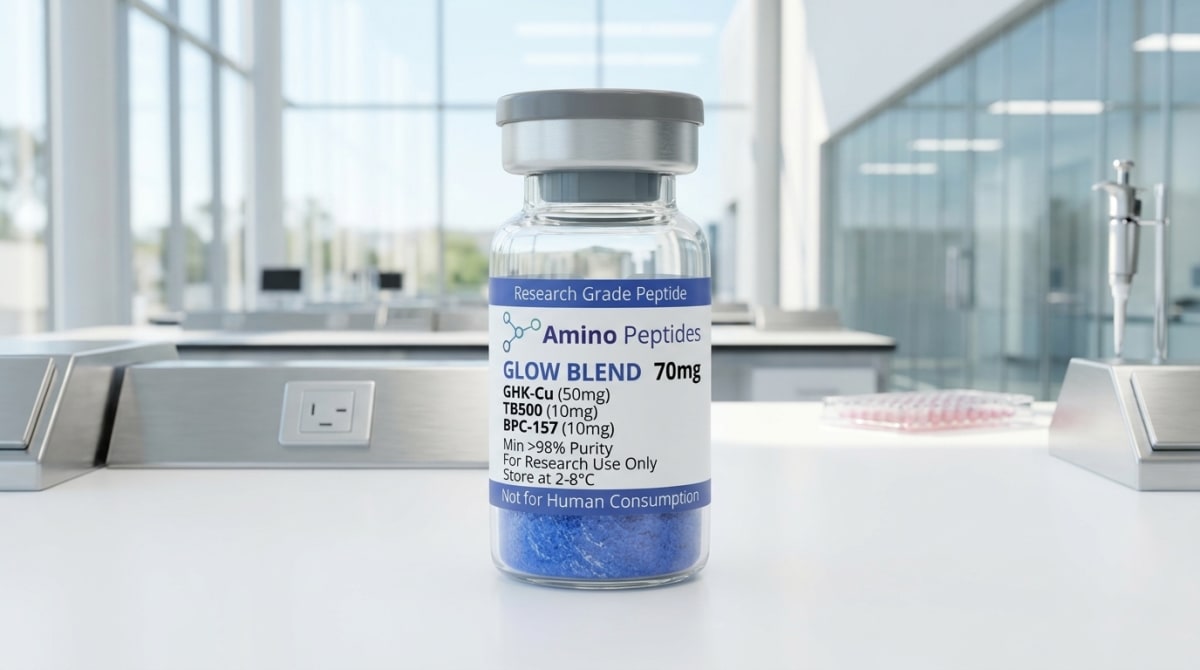
What You Need to Know About GLOW BLEND
- Curious readers often search for the Glow Peptide blend to separate viral social media hype from verified biochemical facts regarding skin and tissue appearance.
- In plain English, these three short amino acid chains act like tiny biological switches that signal cells to organise structural proteins and manage local inflammation.
- Published studies on the individual components have observed increased collagen production, faster cell migration, and newly formed blood vessels in laboratory models.
- While internet rumours often portray this blend as an instant miracle, the factual science shows its components are strictly research tools investigated in preclinical models rather than approved consumer products.
The Real Biology Behind the Glow Peptide Blend
The phrase 'Glow Peptide' is not a single molecule, but rather a nickname for a three-part research blend combining GHK-Cu, BPC-157, and TB-500. Published studies show this trio targets skin elasticity and tissue remodelling by pairing copper-driven collagen assembly with rapid cellular migration.
When we examine Glow Peptide: Fact vs. Fiction, the biggest myth is that one mystery sequence creates an overnight transformation. In reality, laboratory models look at how three separate chains share the workload. The star of the mix is GHK-Cu, a naturally occurring tripeptide bound to a copper ion. In cell culture studies, GHK-Cu acts like a biological courier, delivering elemental copper directly to fibroblasts. Once inside, these cells ramp up their output of type I collagen, elastin, and glycosaminoglycans, which form the springy scaffolding of young dermal tissue.
The fiction often claims that copper peptides alone can rebuild stressed tissue instantly. Published studies show that fibroblasts need proper structural support and blood vessel formation to sustain that output. That is where BPC-157 and TB-500 enter the picture in combined laboratory models. BPC-157 is a fifteen-amino-acid fragment observed to encourage vascular endothelial growth factor expression, which helps build tiny new capillary networks in preclinical models. Meanwhile, TB-500—a synthetic copy of the active region of thymosin beta-4—binds to actin, a structural protein inside cells. By managing how actin links together, TB-500 allows dermal and connective cells to slide across damaged zones much faster. Instead of magic, the blend relies on basic cellular teamwork: moving cells into position, supplying blood vessel pathways, and switching on collagen assembly genes.
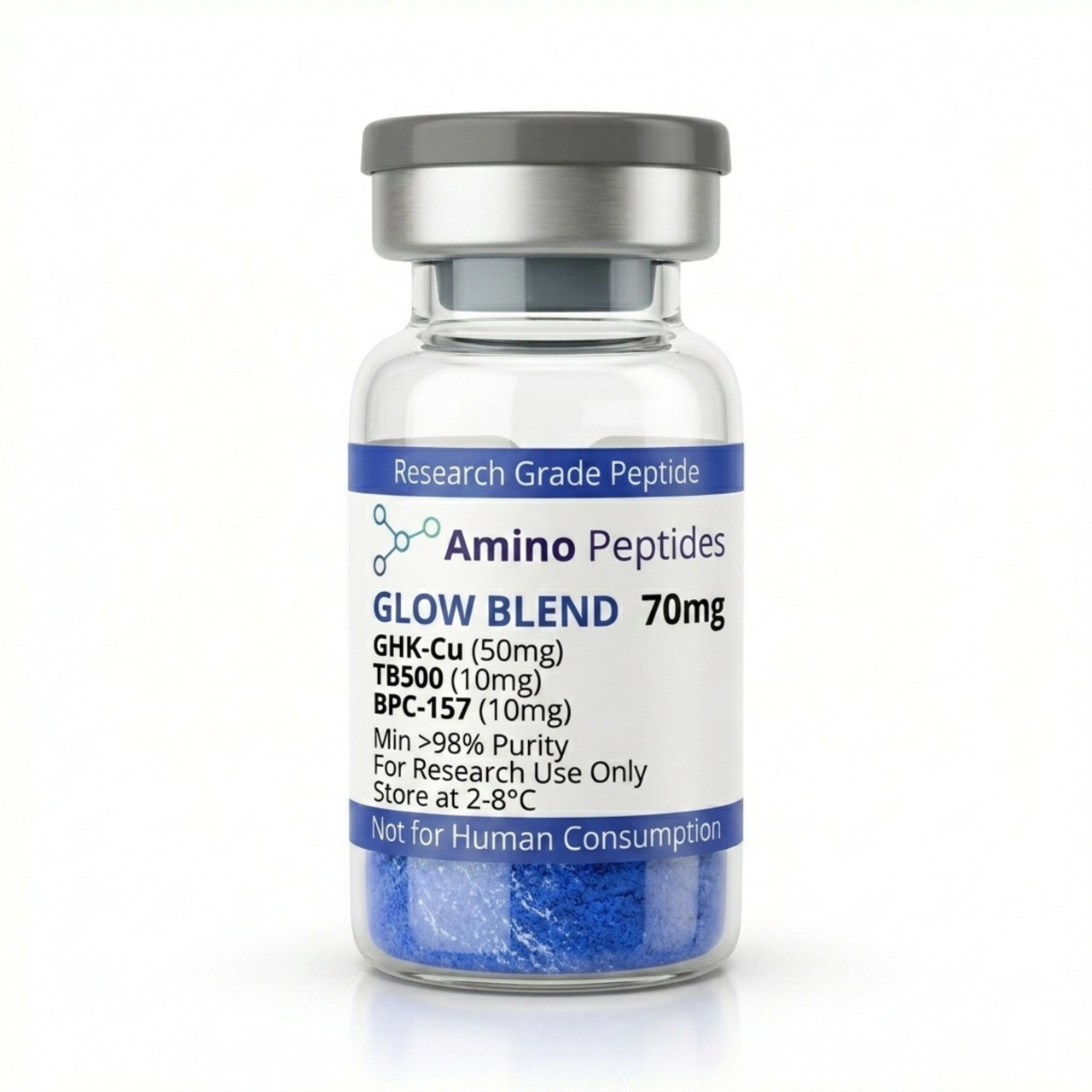
GLOW BLEND
From £65
Supplied as a sealed freeze-dried vial (stable 12–24 months at 2°C–8°C in a standard refrigerator).
Shop GLOW BLEND →Study Timelines: Early Signalling Versus Structural Remodelling
Another major part of sorting out Glow Peptide: Fact vs. Fiction involves expectations around speed. Online rumours often promise visible structural changes within forty-eight hours, yet laboratory models tell a much slower, staged story. Biological repair does not happen all at once; it moves from quiet chemical signalling to heavy physical construction over several weeks.
During the first twenty-four to seventy-two hours of an in vitro experiment, researchers only observe early signalling events. At a measured level in cell dishes, TB-500 and BPC-157 begin mobilising actin filaments and waking up nitric oxide pathways. Nothing looks different under a standard microscope yet. Instead, messenger RNA transcripts start shifting. GHK-Cu begins adjusting the expression of hundreds of genes, dialling down inflammatory cytokines while preparing the recipes for fresh extracellular matrix proteins.
The second phase appears between day seven and day fourteen in preclinical models. This is when fibroblast migration peaks and early granulation tissue begins to form. New capillary sprouts start branching out to feed the active area, and loose, unorganised collagen fibres appear. However, true skin elasticity and dense tissue remodelling take much longer. Published studies tracking dermal thickness and collagen cross-linking usually run for twenty-eight to sixty days. It takes weeks for enzymes like lysyl oxidase—which also depends on the copper brought in by GHK-Cu—to weave loose pro-collagen strands into tight, resilient bundles. Anyone expecting full structural turnover in a single week is misreading how fast mammalian cells can physically spin new protein fibres.
Glow Peptide Blend Components: Fact vs. Fiction Breakdown
| Component or Concept | Popular Internet Fiction | Published Laboratory Fact | Primary Biological Pathway |
|---|---|---|---|
| The 'Glow Peptide' Name | It is a single, newly discovered molecule engineered specifically for cosmetic beauty. | It is an informal nickname for a three-part research blend combining GHK-Cu, BPC-157, and TB-500. | Multi-pathway synergy targeting extracellular matrix remodelling and cellular recovery. |
| GHK-Cu (Copper Tripeptide-1) | It instantly erases aging signs overnight by physically filling in the skin. | Published studies show it gradually modulates gene expression and stimulates fibroblasts to produce collagen and elastin. | Copper-transport signalling, antioxidant enzyme upregulation, and metalloproteinase regulation. |
| BPC-157 (Pentadecapeptide) | It acts as an approved, all-purpose systemic enhancer for immediate whole-body recovery. | Preclinical models demonstrate it accelerates tendon, ligament, and gut tissue repair largely in rodent studies. | Upregulation of growth hormone receptors on fibroblasts and nitric oxide pathway modulation. |
| TB-500 (Thymosin Beta-4 Fragment) | It permanently builds new muscle mass and replaces physical conditioning. | Laboratory models observe that it binds to actin to help cells migrate to sites of tissue damage. | Actin sequestration, endothelial cell migration, and angiogenesis signalling. |
| Co-formulation Stability | Mixing any peptides together in one vial always increases their strength without drawbacks. | Combining copper-bound peptides with other chains requires precise pH control in a bacteriostatic reconstitution solution to prevent degradation. | Peptide bond stability and metal-ion chelation equilibrium in aqueous solutions. |
Complementary Blends and Popular Research Stacks
Because the Glow blend already combines three active sequences, researchers often examine how its individual parts interact with other laboratory compounds. Looking at how these chains pair up helps clarify why certain protocol ratios are favoured in experimental setups. For instance, while GHK-Cu, BPC-157, and TB-500 handle matrix density and cell movement, some laboratory models introduce growth factor splice variants to study local muscle and connective tissue interactions. In assays measuring mechanical strain, investigators might use an mgf antibody or the mechano-growth factor peptide itself alongside TB-500 to see how satellite cells respond when actin motility is already elevated.
In dermal and cellular longevity research, another frequent pairing involves Epitalon or SNAP-8. While the Glow trio focuses on the deeper dermal scaffolding, octapeptides like SNAP-8 are studied in topical or shallow-layer models for their ability to relax mechanical tension across surface proteins. Pairing structural builders with tension-relaxing sequences allows scientists to observe two different angles of tissue smoothing at the same time.
Researchers also explore how systemic circadian and cellular stress signals influence local tissue recovery. Some experimental designs compare peripheral tissue remodelling blends against cognitive research peptides such as Semax or Selank, which regulate brain-derived neurotrophic factors and stress-response genes in preclinical models. The central takeaway from these combination studies is that peptides do not compete when their receptor targets are distinct; GHK-Cu works through copper transport and gene transcription, TB-500 works on cytoplasmic actin, and BPC-157 influences growth factor receptors.
Reconstitution calculator
Choose a vial mass and a bacteriostatic reconstitution solution volume. The figure is the resulting concentration.
Concentration: 2.50 mg/mL
Per 0.01mL (10µL): 25.0 mcg
Open the full calculatorBacteriostatic reconstitution solutionWhy HPLC Purity and Cold Storage Rule the Lab
When evaluating Glow Peptide: Fact vs. Fiction, the most overlooked variable is the physical quality of the vial itself. A blend containing three separate peptides is difficult to manufacture cleanly, and low-grade batches frequently ruin laboratory data before an experiment even starts. High-Performance Liquid Chromatography (HPLC) testing at ninety-nine percent purity or higher is essential for any legitimate research batch. When a blend falls below this mark, the leftover percentage is rarely harmless dust; it usually consists of truncated amino acid fragments that failed to link properly during solid-phase synthesis.
An even bigger issue in multi-peptide vials is trifluoroacetic acid, or TFA. Manufacturers use TFA to cleave finished peptide chains from their resin beads. If the lab skips proper ion-exchange chromatography to remove it, excess TFA remains trapped in the freeze-dried cake. In delicate fibroblast cultures, residual TFA alters the pH of the liquid medium and causes cellular irritation, completely masking the regenerative signalling of GHK-Cu and BPC-157. Cleanly lyophilised vials replace harsh TFA salts with gentle acetate salts.
Storage conditions also decide whether the copper complex stays intact. Lyophilised powders can handle short transit times, but once mixed with a bacteriostatic reconstitution solution, the liquid blend must stay refrigerated between 2°C and 8°C. Warm room temperatures allow the long amino acid chain of TB-500 to unfold and oxidize, while repeated freeze-thaw cycles snap the delicate peptide bonds. Keeping the vial cold and away from bright light preserves the exact protocol ratio from the first measurement to the last.
Frequently Asked Questions
Why are so many people searching for the Glow peptide blend right now?
People are searching for this blend because social media platforms often discuss how GHK-Cu, BPC-157, and TB-500 might support tissue remodelling. In laboratory models, scientists study these three compounds to analyse how they affect cellular signalling, collagen production, and blood vessel growth during the recovery process.
What is the typical timeline observed in published studies for these compounds?
Published studies usually observe changes in cellular activity within two to four weeks depending on the measured level used. In preclinical models, researchers note that early gene expression shifts happen within days, while full structural tissue regeneration and collagen organisation take several weeks of observation.
Why do researchers combine GHK-Cu, BPC-157, and TB-500 into a single stack?
Researchers combine these three peptides to see if their different biological pathways work together to optimise tissue repair. While GHK-Cu focuses on skin remodelling and collagen, BPC-157 and TB-500 are studied for how they guide cell migration and blood flow in laboratory models.
How do laboratories verify purity and handle fridge storage for this blend?
Laboratories verify reaching a ninety-nine percent purity standard by using High-Performance Liquid Chromatography and Mass Spectrometry testing before any experiments begin. Once mixed with a bacteriostatic reconstitution solution, the liquid compound must be kept in cold fridge storage between two and eight degrees Celsius to prevent degradation.
Bibliography
- Pickart L, Margolina A. Regenerative and Protective Actions of the GHK-Cu Peptide in the Light of the New Gene Data. International Journal of Molecular Sciences. 2018;19(7):1987. View published research
- Pickart L, Vasquez-Soltero JM, Margolina A. GHK Peptide as a Natural Modulator of Multiple Cellular Pathways in Skin Regeneration. BioMed Research International. 2015;2015:648108. View published research
- Seiwerth S, Milavic M, Vukojevic J, et al. Stable Gastric Pentadecapeptide BPC 157 and Wound repair. Frontiers in Pharmacology. 2021;12:627533. View published research
- Chang KV, Tsai K, Wu WT, Ozcariz E, Lin CP. Pentadecapeptide BPC 157 Enhances the Growth Hormone Receptor Expression in Tendon Fibroblasts. Molecules. 2014;19(11):19066-19077. View published research
- Goldstein AL, Hannappel E, Sosne G, Kleinman HK. Thymosin beta4: a multi-functional regenerative peptide. Basic properties and preclinical applications. Expert Opinion on Biological signalling. 2012;12(1):37-51. View published research
⚠️ Research Use Only Disclaimer: All peptides and compounds are sold strictly for in-vitro laboratory research purposes only. Not intended for human or veterinary use, not a dietary supplement, and not approved to diagnose, treat, cure, or prevent any disease or condition. For use by qualified researchers in suitably equipped laboratory environments only. Amino Peptides Ltd operates in full compliance with UK MHRA regulations and applicable EU research chemical guidelines.